



As we age, our face naturally loses volume, structure, and support. Cheeks begin to flatten, lines deepen, the jawline softens, and the under-eye area starts to look hollow or tired. These changes happen not just because the skin ages on the surface, but because the fat, bone, and tissue beneath the skin gradually shift and reduce over time. The face loses its three-dimensional fullness, and with it, a sense of youth and vitality.
Hyaluronic acid (HA) dermal fillers address this by restoring what has been lost. Hyaluronic acid is a substance your body produces naturally, and it plays a central role in keeping tissue plump, hydrated, and supported. As we age, our natural hyaluronic acid levels decline, which is one of the key reasons certain areas of the face begin to look deflated or hollow.
When injected, HA fillers attract and hold water molecules within the tissue, creating volume and providing structural support to the surrounding area. Depending on where and how they are placed, they can restore lost fullness, smooth lines that are present even at rest, define and contour features, and create a subtle three-dimensional lift that surgery once had the monopoly on.
The results are visible immediately. And unlike surgical procedures, the treatment is minimally invasive, requires no general anaesthesia, and involves very little downtime.
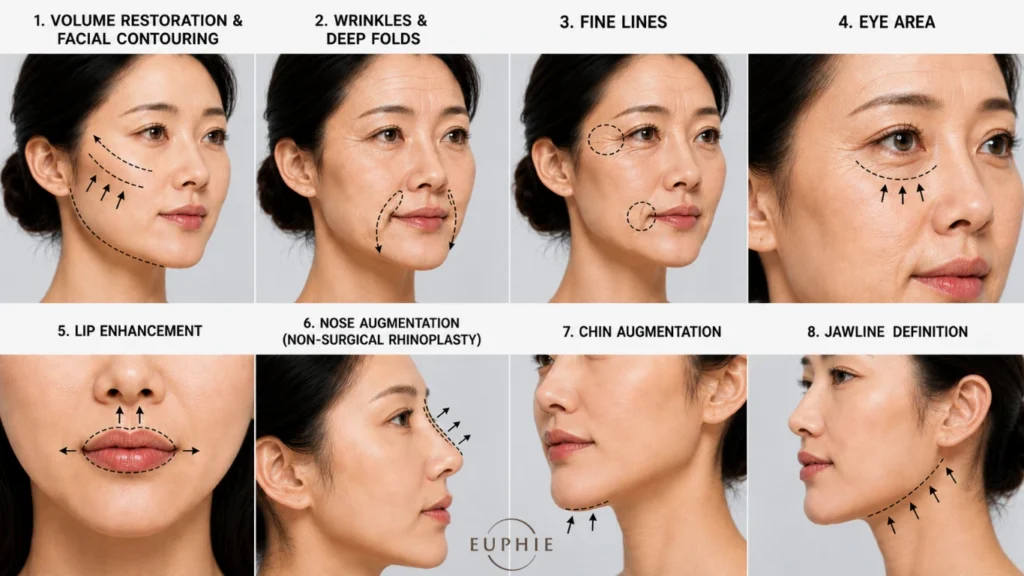
As the fat pads beneath the skin shift and reduce with age, the face can look flatter, heavier in the lower face, or less defined overall. Fillers placed precisely in the cheeks and along the jawline restore vertical structure and lift, creating a more balanced and youthful facial shape. This also helps improve the proportion between the upper and lower face, and can subtly slim the appearance of a wider or rounder face by restoring the structure that supports it.
Lines that run from the sides of the nose to the corners of the mouth, or from the corners of the mouth downward, form as collagen declines and the fat pads beneath the skin descend with age. Fillers injected beneath these lines restore the support that was lost, pushing the skin back up from below and smoothing the area immediately. For moderate to deep lines and folds, the improvement is visible right after the session.
For finer, more superficial lines, particularly around the mouth and eyes, a softer filler formulation is used. Because it blends seamlessly into the skin without adding bulk, it smooths delicate lines while keeping the result looking completely natural.
Hollowness or dark shadows under the eyes can make a person look consistently tired or older than they feel, even when they are perfectly well-rested. Fillers can restore volume in this area and reduce the shadowing caused by the hollow, resulting in a smoother, more rested appearance around the eyes.
Fillers can add volume, define the borders, and improve the overall shape of the lips. This includes restoring lips that have thinned with age, or subtly enhancing volume and symmetry for younger patients. The approach is always tailored to the individual’s natural lip shape and facial proportions, with the goal of looking natural rather than obviously augmented.
A non-surgical nose job using filler is one of the most technically demanding but rewarding treatments in aesthetic medicine. Small, precise injections can raise the nose bridge, refine the nasal tip, improve symmetry, and correct minor bumps, all without surgery. Results are immediate, and the treatment is fully reversible.
A well-defined chin and jawline are central to facial balance. Fillers placed at the chin can improve its projection and shape, creating a more defined profile. Along the jawline, fillers restore structure and definition that has softened with age or was never strongly present to begin with.
At Euphie Clinic, we use four of the most established hyaluronic acid filler brands in aesthetic medicine. Each has a different molecular structure, consistency, and strength, which is why doctors select specific products for specific areas and goals rather than using one product for everything.
Juvederm (Allergan / AbbVie) is the most widely used HA filler family in the world, with the broadest range of formulations from very firm to very soft. Juvederm’s VYCROSS technology produces a smooth, cohesive gel that integrates well into the tissue and is known for its longevity, lasting up to 12 to 24 months in the right areas. It is particularly well-suited for structural work: cheeks, jawline, chin, and deeper folds.
Belotero’s (Merz Aesthetics) unique polydensified matrix technology produces a softer, more flexible gel that blends exceptionally well into superficial layers of the skin. This makes it the go-to for fine and delicate areas, particularly around the eyes, lips, and finer surface lines. It also has a very low risk of creating a bluish tint under the skin (the Tyndall effect), which can sometimes occur with other fillers when injected close to the surface.
Teosyal (Teoxane) is a Swiss-made filler range known for its high purity and range of formulations. Teosyal is particularly valued for its natural feel in the tissue and its versatility across both structural and delicate areas. Its RHA (Resilient Hyaluronic Acid) range is specifically designed to move naturally with facial expressions, making it a strong choice for dynamic areas like the lips and nasolabial folds.
Your doctor at Euphie will recommend the most appropriate product based on your concern, anatomy, and goals.
Not all dermal fillers are made from hyaluronic acid. Understanding the differences matters, because they have different properties, longevity, risks, and reversibility profiles.
HA Fillers vs Collagen-Based Fillers. Collagen-based fillers were among the earliest injectable dermal fillers used in aesthetic medicine. While they can still be found in limited use today, they have largely been replaced by newer options. Earlier collagen fillers were associated with a higher risk of allergic reactions and often required pre-treatment skin testing, and their duration of effect was generally shorter compared to modern fillers. As a result, collagen-based fillers are now less used in routine aesthetic practice.
HA Fillers vs Biostimulator Fillers (Radiesse / Sculptra). Biostimulator fillers such as calcium hydroxylapatite (Radiesse) and poly-L-lactic acid (Sculptra) differ from hyaluronic acid (HA) fillers in their primary mechanism of action. Rather than providing immediate volume through gel placement alone, they work by stimulating the body’s own collagen production over time, leading to gradual improvements in skin firmness and structure. The results typically develop more slowly compared to HA fillers but may last longer in appropriate candidates.
However, they come with important differences. They are not reversible. If the result is not as expected, there is no dissolving agent equivalent to hyaluronidase for these products. Radiesse and Sculptra also require a different approach to aftercare and carry their own risk profile. For this reason, they are typically recommended for specific indications by experienced doctors and are not a substitute for HA fillers across all areas of the face.
HA Fillers vs Fat Grafting. Fat grafting (autologous fat transfer) involves taking fat from another part of the body and injecting it into the face. It is a surgical procedure with longer downtime, and while results can be long-lasting, the take rate of the transferred fat is variable and unpredictable. HA fillers offer a non-surgical, predictable, and reversible alternative that suits most patients who want meaningful facial rejuvenation without surgery.
These two treatments are often confused because they both contain hyaluronic acid, but they are fundamentally different in what they do and how they are used.
Dermal fillers use a denser, cross-linked form of hyaluronic acid. The cross-linking process creates a stable gel that holds its shape in the tissue, which is what allows it to add volume, provide structural support, and contour specific areas. Fillers are placed at deeper levels beneath the skin.
Skin boosters use a lighter, non-cross-linked or minimally cross-linked form of hyaluronic acid that is injected superficially into the skin itself. Rather than adding structure or volume, skin boosters work by deeply hydrating and repairing the skin from within, improving its texture, elasticity, and radiance. The effect is a visible improvement in skin quality, not a change in facial shape or volume.
In simple terms, fillers change the shape and structure of the face. Skin boosters improve the quality and condition of the skin. Both are valuable, and many patients benefit from both as part of a comprehensive treatment plan.
Dermal filler treatments may appear straightforward, but the skill of the person performing them, and the quality of the product being used makes an enormous difference to both safety and outcome.
Certification and experience. Aesthetic medicine requires formal training, ongoing education, and genuine clinical experience to be done safely. At Euphie Clinic, our doctors are certified practitioners with proper aesthetic medicine training. The injector’s skill, judgment, and understanding of facial harmony are ultimately what determine whether a result looks natural, balanced, and beautiful, or overdone and off.
Authentic products from authorised distributors. This is a significant and underappreciated issue. Counterfeit or substandard filler products exist in the market, and they are more common than most patients realise. Unregistered practitioners and beauty salons that cannot source genuine products from official brand distributors may use products that are incorrectly labelled, improperly stored, or not what they claim to be. The consequences can range from poor or unpredictable results to infection, granuloma formation, and serious tissue damage.
Facial anatomy and injection technique. The face contains critical structures, including arteries, veins, and nerves. An injection placed incorrectly, at the wrong depth, or in the wrong location, can compress or occlude a blood vessel, which in rare but serious cases can lead to skin necrosis or visual complications. These risks are real, which is why proper training in facial anatomy is non-negotiable. An experienced aesthetic doctor knows where these structures are, how to adjust technique based on individual anatomy, and how to recognise and manage complications immediately if they occur.
At Euphie Clinic, all filler products are sourced exclusively from the authorised Malaysian distributors of each brand, with full traceability and cold-chain compliance. Every product we inject is exactly what it says on the label.