PRP (Platelet Rich Plasma)

PRP is a regenerative treatment that uses a concentrated form of your own blood to stimulate healing, collagen production, and tissue repair. Rich in growth factors, PRP works by supporting the body's natural regenerative processes to improve skin quality, acne scars, fine lines, and hair thinning. Because the treatment uses your own biological material, it is highly biocompatible and provides gradual, natural-looking improvements with minimal downtime.

Sessions Required
3 sessions and above
Duration of Results
Several months with maintenance sessions
Session Duration
45–60 mins
Downtime
Mild redness, swelling, or injection marks for 1–3 days
Skin Concerns
Acne scars Damaged skin barrier Dull Skin Enlarged pores Fine Lines & Wrinkles Hair thinning Loss of Skin Firmness Uneven skin texture
Acne scars
Damaged skin barrier
Dull Skin
Enlarged pores
Fine Lines & Wrinkles
Hair thinning
Loss of Skin Firmness
Uneven skin texture

What is PRP?

PRP stands for Platelet Rich Plasma. It is a regenerative treatment that uses a concentrated form of your own blood to stimulate healing, collagen production, and tissue repair in targeted areas.

In a PRP treatment, a small amount of blood is drawn from your arm, exactly like a standard blood test. This blood is placed into a centrifuge, a machine that spins it at high speed to separate it into its different layers. The platelet-rich layer is then carefully extracted. In this concentrated form, the level of platelets and growth factors can be 5 to 10 times higher than what normally circulates in the bloodstream. This concentrated PRP is what gets injected into the treatment area.
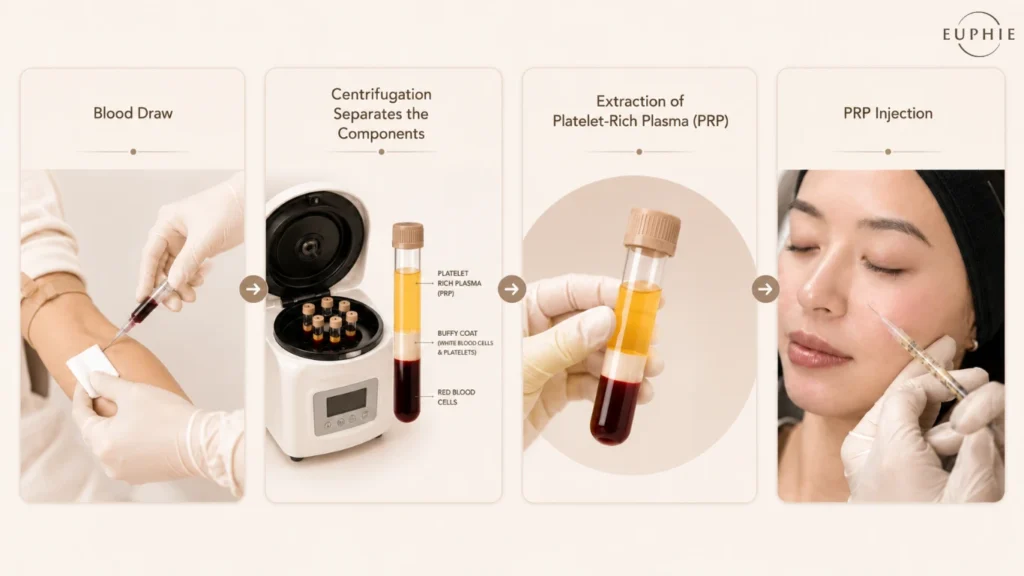
How Does PRP Work?

Once the concentrated PRP is injected into the target area, the growth factors signal the body to accelerate its natural repair processes.

In the skin, this means stimulating the production of new collagen and elastin, improving skin quality, texture, and firmness from within. On the scalp, the growth factors work to wake up dormant hair follicles and improve the environment around them to support healthier, thicker hair growth. 

Because everything used in PRP comes entirely from your own body, the risk of rejection or adverse reaction is very minimal.
Key Benefits of PRP

  • 100% natural: Uses only your own blood with no synthetic or foreign substances involved.

  • Stimulates your own collagen and elastin: Growth factors trigger the skin’s own repair and rebuilding process.

  • Versatile: Addresses both skin rejuvenation and hair loss using the same treatment approach.

  • Safe for all skin tones: No heat or laser energy involved, so there is no risk of further pigmentation or darkening.

  • Mild downtime: Most patients can return to normal activities the same day.

  • Works well with other treatments: Frequently combined with lasers, RF microneedling, and skinboosters for enhanced results.

  • Gradual, natural-looking improvement: Results develop progressively as new collagen forms and hair follicles respond over time.

What Can PRP Treat at Euphie?

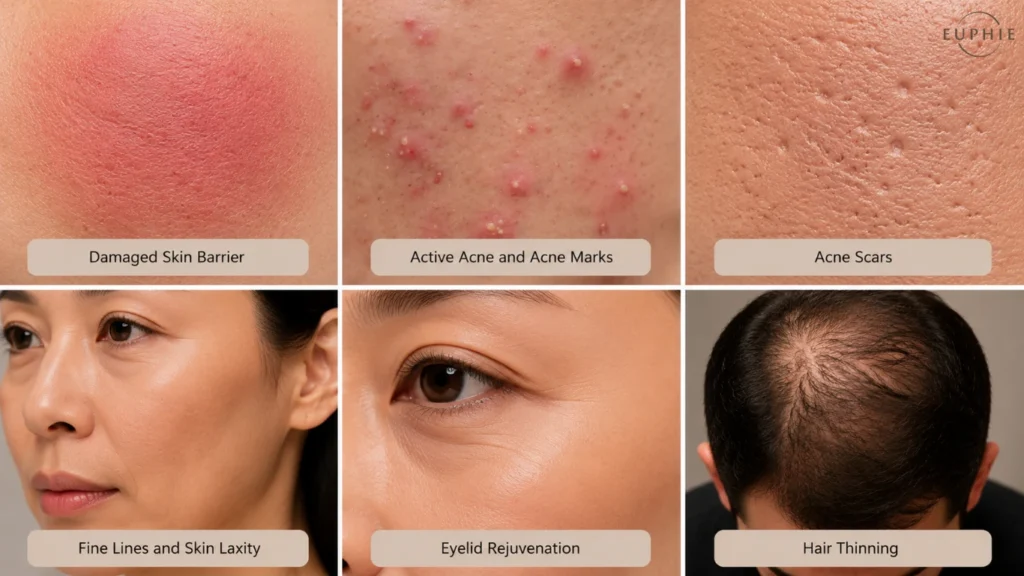
1. Damaged Skin Barrier

A compromised skin barrier often presents as persistent sensitivity, redness, dryness, or reactive skin that struggles to tolerate products it previously handled well. The growth factors in PRP support the skin’s natural repair mechanisms, helping to restore barrier integrity, reduce inflammation, and improve the skin’s overall resilience over a course of sessions.

2. Active Acne and Acne Marks

PRP helps regulate inflammation in the skin, which makes it a useful complementary treatment for patients with active acne. For acne marks and post-inflammatory redness left behind after breakouts resolve, the growth factors stimulate cellular turnover and collagen renewal, gradually fading discolouration and improving the skin’s overall evenness.

3. Acne Scars

Acne scars form when inflammation damages the collagen structure beneath the skin, leaving behind depressed marks, textured patches, or areas of unevenness. PRP delivers a concentrated dose of growth factors directly into these areas, triggering the body’s repair response and encouraging the formation of new, organised collagen to gradually fill and smooth the scarred tissue. It is particularly effective when combined with treatments such as Sylfirm X or laser resurfacing for more comprehensive scar improvement.

4. Fine Lines and Skin Laxity

The growth factors in PRP stimulate collagen and elastin production throughout the treated area, which directly addresses the loss of firmness and the appearance of fine lines. Over a course of sessions, the skin becomes progressively firmer, more elastic, and more resilient. It is a particularly popular option for patients in their 30s to 50s who want meaningful skin improvement without the use of fillers or laser treatments.

5. Eyelid Rejuvenation

The skin around the eyes is the thinnest and most delicate on the face, and it tends to show the earliest signs of ageing, including fine lines, crepiness, hollowing, and dark circles related to poor microcirculation. PRP is well suited for this area because it uses no heat and carries no risk of pigmentation changes, making it a safe option where laser and energy-based treatments require more caution. The growth factors improve skin quality, microcirculation, and tissue repair in this sensitive zone.

6. Hair Thinning

PRP for the scalp is one of the most well-researched non-surgical options for patients experiencing hair thinning or loss. When injected into thinning areas, the growth factors work to wake up dormant hair follicles, improve blood circulation around them, slow down follicle shrinkage, and encourage the growth of thicker and healthier hair strands. PRP works best when follicles are still present, even if weak or inactive. It is less effective in areas where follicles have been completely lost. At Euphie, PRP for hair loss is often combined with Fotona Hair Restore Laser or medications such as Minoxidil for stronger results.

Frequently Asked Questions

Is PRP painful?

Most patients find it very manageable. A numbing cream is applied to the treatment area before the injections begin to minimise discomfort. The blood draw from the arm feels the same as a standard blood test. Overall, most patients rate the experience as mild discomfort.

For skin rejuvenation, some patients notice a subtle improvement in radiance within the first week. More visible improvements in texture, fine lines, and scar appearance typically become noticeable around 4 to 6 weeks after the session. For hair loss, visible improvement in thickness and density is generally seen at around 3 to 6 months after beginning the treatment course.

Yes. Because PRP is made entirely from your own blood, the risk of an allergic reaction or rejection is extremely low. It is considered one of the safest injectable treatments available. The equipment used to prepare the PRP is sterile and single use. PRP should always be performed by trained medical professionals in a licensed clinic.

Yes, and combination approaches often produce the strongest results. For skin, PRP pairs well with Pico Majesty Laser, Sylfirm X, and skinboosters. For hair loss, it works particularly well alongside Fotona Hair Restore Laser and topical treatments such as Minoxidil. Your doctor will advise the safest and most effective combination for your specific goals.

PRP is not recommended for individuals who are pregnant, have blood disorders or severe anaemia, have active infections or skin conditions in the treatment area, have certain autoimmune conditions, or are on immunosuppressant medications. A thorough consultation with our doctors at Euphie will confirm your suitability before any treatment begins.

For skin rejuvenation, results typically last several months with maintenance. For hair loss, results depend on the individual and whether the underlying cause of thinning continues to progress. PRP does not permanently stop hair loss, so regular maintenance sessions are needed to sustain improvements over the longer term. Your doctor will advise the most appropriate maintenance schedule for your situation.

Beyond aesthetics and hair loss, PRP is an active area of research across several medical fields. In orthopaedics, it is being studied as a treatment for joint pain, tendon injuries, and osteoarthritis, with the goal of using concentrated growth factors to support tissue repair and reduce inflammation without surgery. In female reproductive medicine, researchers are investigating PRP’s potential to support uterine lining health and improve outcomes in certain fertility treatments. It is also being explored in the context of erectile dysfunction, where improved blood vessel formation and tissue repair may support better function. In wound care, particularly for diabetic foot ulcers, PRP has shown promising results in accelerating healing in tissue that is otherwise slow to repair due to poor circulation and a compromised immune response. While these applications are still under active research and are not yet standard practice across all medical settings, they speak to the broader potential of the body’s own regenerative biology when concentrated and applied with precision.